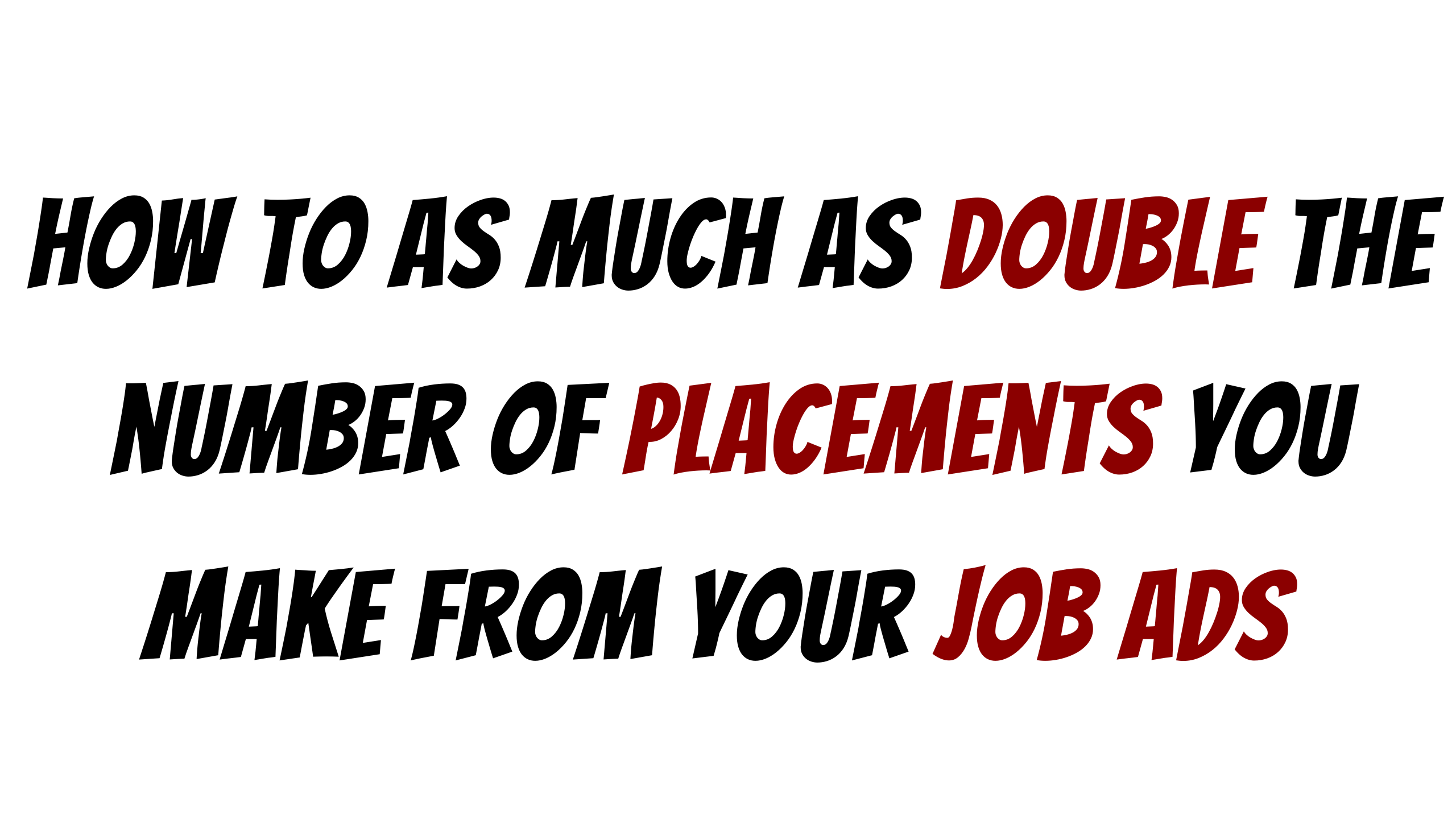
Let’s deal with the elephant in the room.
This website is…
Butt Ugly!
It’s just one page of mostly black text on a white background, and has no fancy graphics, videos, or other shiny baubles whatsoever.
If you’re a fragile type who prefers pretty pictures, probably because you believe the best way to source candidates involves asking ChatGPT to spit out an ad that positions the statutory 28 days annual leave (including bank holidays) as some sort of benefit, this link will take you back to LinkedIn where you belong.
On the other hand…
If you are a thinking person, you will recognise that the vast majority of the time, text is all you’ve got to “sell” a job to a candidate. So I think it’s only fair I try to “sell” you on the idea of us working together using text and text alone.
Listen: There’s something deeply wrong with how recruiters present their vacancies to the market.
You feel it.
Candidates feel it.
And your clients feel it, too.
On that note, we begin with:
The Nature and Extent of the Problem
Job adverts written by recruiters are routinely terrible.
The consequences of this are profound and include:
* Thousands, potentially tens of thousands of pounds wasted annually on job listings that either get no response or, worse, attract unqualified candidates (who you either have to waste time managing or risk harm to your reputation by ignoring or sending a callous automated rejection).
* Hours upon hours of time down the drain that you could (nay, should) have invested into directly approaching candidates to fill tricky but lucrative vacancies or growing your business by finding new clients, deepening relationships with existing clients, and so on.
* Looking like a plonker who doesn’t understand what candidates want or why (meaning they work with you because they have to, not because they want to), and,
* Upsetting clients when they see how you are representing their businesses (they pay you because you profess to have the ability to think and act differently, so they are understandably disappointed when your ads make their firm look like a tin of Smart Price beans; and you can’t blame them for refusing to give you more work, let alone low-stress and wildly profitable exclusive terms).
Combined, this potentially means…
You are attracting low quality candidates, what placeable candidates you do attract apply not because, but in spite of you… and… all the while you’re spending more time and money to make fewer placements under less favourable terms
Ooh. That’s a problem.
And as much as I’d like to claim just writing better ads is the cure, that’d be a lie.
No.
Solving the problem properly (i.e. in a way most likely to produce a favourable outcome) requires a “root and branch” approach that’s broadly as follows:
List, Offer, Copy
In that order.
Copywriters are a strange bunch. Many of us like to think we can “compel” people to buy just about anything with our “magic” words.
Not true.
Actually, the words are the least important part of the whole equation.
What is this?
Have I just gone and undermined my entire pitch?
Am I insane?
Perhaps. Although I prefer to think I am honest.
Because, the fact of the matter is, the best written ad in the world will bomb if it’s selling a gash offer and sent to a crappy list.
Consider: Let’s pretend you write a job ad for a mid-level hire.
The ad itself is excellent. Clear, specific, detailed. The job is solid, too. Plenty of perks on offer for the successful candidate plus plenty of opportunities to make deep and meaningful strides in their career (more than a “competitive” salary and the chance to “liaise with stakeholders”, in other words).
But.
You put it on your website (which gets no traffic) and share it via a post on LinkedIn (which gets all of about 17 impressions)… and then…
Crickets!
How about another example: Same well written mid-level ad, and, this time you spend a little extra to post it on an industry-specific job board that gets loads of high-quality, high-intent traffic.
The issue this time is that the job is for a corporation with a less-than-stellar reputation. You are on the third tier of their PSL and your only contact is a HR manager who “hates recruiters” and refuses to speak to you on the phone, so you’ve only got a vague job spec to go on and can’t influence them to improve the package to attract better candidates.
Your ad is technically excellent, but there is no escaping the fact that you are taking a turd to market; and everybody knows…
You can’t polish a turd!
Only cover it in glitter and hope nobody notices the smell.
Anyway.
My point is, seeing greater success from your job ads starts with who you put them in front of, then what you are selling, then (and ONLY then), what you say.
Interestingly, the better job you do of building your list and understanding what, exactly, you are asking potential candidates to apply for, the easier it is to write a specific and detailed advertisement that attracts the placeable and repels the unsuitable.
Speaking of the unsuitable, let’s briefly talk about:
The Scourge of “Easy Apply”
Do you remember how I said one of the problems with naff job ads is that they invariably summon a horde of applications from people who I am sure are very hardworking and mean well, but are not in any way, shape, or form placeable?
The most common objection I get when I mentioned this is how it’s a phenomenon you can’t do anything about because of things like Easy or One-Click apply.
It’s a fair point.
Job boards make it very easy (and I would argue too easy) to apply for roles because it’s in their short-term commercial interest to do so.
Nevertheless, it’s folly to suggest you are as powerless as a hapless babe to do anything about it.
Here, what you say can have an impact; and when you get it right, you’ll not only stem the tide but also dramatically boost your chances of a highly motivated, placeable candidate responding.
Let me explain:
Over the years, I have noticed that people’s IQ tends to drop between 30 and 50 points when confronted with any form of advertising.
Specifically, if the advert is not immediately and obviously relevant to their exact situation, they glaze over and go look at something else. Even if the offer could be just what they’re looking for, if the ad doesn’t resonate in the first instance… if it doesn’t feel like it was written just for them, they disappear off into the undergrowth like a startled rabbit.
On the other hand…
When the ad is immediately and obviously relevant, they’re hooked
And, in all likelihood will ravenously consume the rest then fire off an application.
Weak openers that don’t say much of anything (“Our client is recruiting for…”, “Are you an XYZ who is looking for a dynamic and fast paced role?”, etc.) open the floodgates, info-rich, specific openers are your filter.
How you might construct one of those info-rich, specific openers varies:
* Some bullets (note: a salary band and some points from the job spec attached to vague benefits are NOT good enough),
* What’s frustrating or even terrifying your perfect candidate about their situation (oftentimes, particularly in a downturn, escaping pain is a stronger motivator than a salary jump and benefits),
* The company name (can be a huge draw in and of itself if its prestigious, only use if your relationship with the client is tight and exclusive, obviously),
* One to three huge and unique or at least novel benefits (again, be careful if you’re not exclusive and can’t trust the client to pay your fee if the candidate goes direct, but this can make it child’s play to stand out on a crowded job board).
All of this is very nice, but it sure sounds like a lot of effort to write not only the sort of detailed, specific opener I mentioned but also the whole rest of the ad as well.
You’re right, it is.
So..
Why not use AI?
Lots of reasons.
Here are my favourites:
1. Everyone else is using it (meaning your ads will sound like everyone else’s ads, which is not ideal when you are competing with other companies to fill the same role),
2. AI uses lots of words to say very little (by that I mean it is only really capable of producing generic slop that might read well but tells a candidate next to nothing meaningful about why they should or should not apply for a job),
3. Sometimes, it just makes stuff up (called “hallucination” this is a well-studied phenomenon that occurs because LLMs are designed to pick the next likely word, prioritising what is plausible over what is accurate; meaning, if an AI is writing your ads, there is a non-zero chance that you are misrepresenting your clients’ roles, and you don’t need me to tell you why that is a Very Bad Thing Indeed™),
4. It’s lazy and it shows (and everyone can see it, whether they are prepared to admit it or not).
There are plenty more reasons why I don’t like it, but them’s the bigguns.
OK, it’s about time I told you how I can hand you more placements with less fuss and hassle by giving your job ads the attention they so richly deserve.
So, let’s get down to bidniss.
What I offer
Mine is a simple service.
I’ll either:
Write your ads FOR you – the fee for this is £120 inc. VAT per ad with a minimum of 3 ads per month. I don’t work with prisoners, so you are free to cancel at any time for any reason (or no reason).
“One off” ads are £250 inc VAT, with no ongoing commitment or obligation.
Train you to write ads – This consists of one full days’ training, in person only at a venue of your choice plus three months’ post-training support (includes 3x telephone or video calls, plus regular copy reviews).
The fee for this is £1200 inc. VAT.
I think all of my fees are fair, arguably low compared to what you get, but I’m obviously biased and only you are able to judge if that’s the case from your perspective.
That’s everything.
It’s time for you to make a decision
Reading all of this is basically an admission that your job ads are costing you time, money, and reputation.
So if you want to get to fixing it, right now, today, simply choose from the following options:
1. Book a time in my calendar, here:
https://philtyreman.co.uk/consult/
2. Email me personally. My address is phil@copywritingforsales.co.uk.
When you email, please furnish me with a brief description of your business, where you think your job ads are letting you down, and what results, in an ideal world, you’d like to see if we were to work together.
3. Leave your details, and I’ll call you:
Either way, I’ll ask you lots of detailed and probing questions about you and your business, and you can do the same to me.
Then, if there’s scope for us to work together, I’ll tell you as much, and we can take it from there.
Thank you for your time and attention,
Phil Tyreman

P.S. #1 Thought it’d be worth mentioning I am also in the business of selling shouty and expensive fitness books and newsletters. Perhaps not because you’d be interested in buying any of them, but more as proof that I can create, market, and sell offers unrelated to marketing (a rare skill in my industry, I have noticed).
You’ll find all that stuff here:
P.S. #2 I have written an inventively titled Real Paper book on copywriting called Copywriting For Sales. It’s not currently available for sale as I only have a few copies remaining from the last print run. However, if you’d like one, mention it to me when we talk and I’ll get one out to you post haste.
C M Tyreman Ltd.
All material on this page is the intellectual property of C M Tyreman Ltd. and protected by copyright. Reproduction in any form is prohibited without the written consent of the copyright owner.